Steam, Minerals, and Midnight Light: The Photographer's Guide to Iceland's Glowing Geothermal Waters
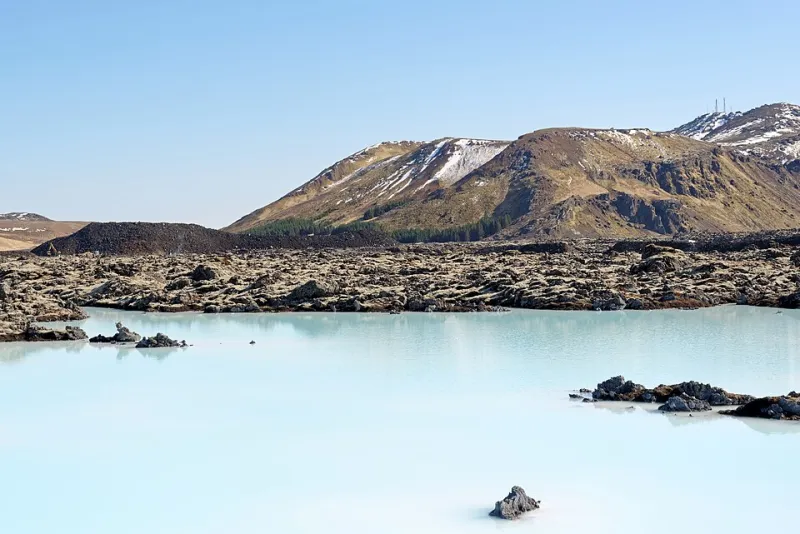
Photo: Jakub Hałun, CC BY-SA 4.0, via Wikimedia Commons
There's a moment that catches almost every photographer off guard the first time they shoot Iceland's geothermal pools in summer. It's around 1 a.m., the sun is still hovering somewhere above the horizon, and the water is doing something that defies easy explanation. It glows. Not in a neon-sign kind of way — more like the light is coming from inside the pool itself, refracting through a mineral-thick soup of silica, algae, and geothermal steam. Your camera's auto white balance is already confused, and honestly, so are you.
This is the geothermal paradox: Iceland's hot springs are most visually dramatic during a season when traditional photography logic stops making sense. No golden hour. No blue hour. Just this relentless, soft, omnidirectional light that wraps around steam clouds and bounces off milky-blue water in ways that no preset on your camera was designed to handle. The good news? Once you understand what's actually happening, these conditions become one of the most rewarding photographic environments Iceland has to offer.
Why the Color Looks Like That
Let's start with the science, because it genuinely informs the photography. The iconic blue-white color of pools like the Blue Lagoon near Reykjavík isn't a filter or a tourist board exaggeration. It comes from silica nanoparticles suspended in the water, which scatter short-wavelength blue light in a process similar to the way Earth's atmosphere makes the sky look blue. Under direct overhead sunlight, this scattering effect is somewhat washed out. But during Iceland's midnight sun — when light arrives at a low, raking angle even at noon — those same particles catch the light differently, intensifying that luminescent quality.
At Mývatn Nature Baths in northern Iceland, the chemistry shifts slightly. The water here is rich in minerals like sulfur and algae, giving it a more greenish-turquoise cast compared to the Blue Lagoon's cooler palette. The steam rising from the surface acts like a natural diffusion filter, softening contrast and wrapping subjects in a gauzy haze that's genuinely difficult to replicate in post-processing. These two locations alone offer dramatically different color problems to solve — and that's before you factor in the time of day.
The White Balance Problem (And How to Use It)
Here's where a lot of photographers get tripped up. During Iceland's summer, the color temperature of ambient light shifts constantly — not because the sun is rising or setting in any conventional sense, but because it's circling the horizon at different angles throughout the day. At 11 p.m., you might be dealing with a warm 4,500K light. By 2 a.m., that same sun has dipped slightly and the light takes on a cooler, more diffused quality closer to 5,500–6,000K. By 5 a.m., it's warming up again.
Shooting in RAW is non-negotiable here. Set your white balance manually if you want consistency across a shoot, or shoot on Auto and plan to correct in Lightroom or Capture One. The key insight is that the "wrong" white balance is often the most interesting one. A slightly cool white balance on the Blue Lagoon at midnight pulls the water toward an almost otherworldly teal. A warmer setting at Mývatn can make the steam columns look like they're lit from below, like something out of a fantasy film. Experiment deliberately rather than chasing technical accuracy.
Composition Strategies When You Can't Use Darkness
In standard travel photography, steam and mist are usually captured by contrast — bright vapor against a dark sky, or glowing water against a shadowed landscape. In summer Iceland, you lose that contrast almost entirely. The sky is light, the landscape is light, and the water is light. Everything competes.
The solution is to get low and get close. By dropping your shooting angle to near water level, you create a compression effect where the steam columns rise dramatically against the distant landscape rather than disappearing into a uniform bright sky. At the Blue Lagoon, this works especially well near the lava rock formations that border the pool — the dark, textured basalt provides the contrast that the sky refuses to give you.
Silhouettes are another underused tool in this context. Bathers or fellow photographers standing at the pool's edge, backlit by that low-angle midnight sun, become graphic shapes that anchor the frame. The steam swirling around them adds layering and depth. You're not fighting the flat light anymore — you're using human forms as compositional anchors within it.
Timing Is Still Everything
Just because the sun never sets doesn't mean all hours are equal. The window between roughly 11 p.m. and 2 a.m. is genuinely special at Iceland's geothermal sites. Visitor numbers drop significantly (even at the Blue Lagoon, which manages crowd flow carefully), the light angle is at its most interesting, and the temperature differential between the warm water and the cooler night air produces denser, more photogenic steam clouds.
If you're visiting Mývatn, the surrounding landscape — including the pseudo-craters at Skútustaðagígar and the bizarre lava formations of Dimmuborgir — is worth shooting in this same window. The geothermal area sits within a broader volcanic landscape that rewards wide-angle compositions, particularly when the low sun casts long shadows across the crater fields while the pool itself glows in the middle distance.
Practical Gear Notes
Silica-rich water is hard on camera equipment. Keep your gear in a dry bag when you're not actively shooting, and be aware that the steam carries mineral particles that can settle on front elements. A UV filter you're willing to clean frequently is worth using here. Lens cloths are essential — pack more than you think you need.
For most geothermal pool photography, a 24–70mm equivalent range covers the majority of situations. If you want to isolate steam details or compress the landscape behind the pool, a 70–200mm is genuinely useful. Bring a small, lightweight tripod for longer exposures if you want to smooth out the water surface — even in bright conditions, a 2–4 second exposure at f/16 will give you that glassy, reflective quality that makes these shots feel meditative rather than snapshot-like.
Iceland's geothermal pools under the midnight sun are one of those photographic subjects that rewards patience and punishes assumptions. Come with a plan, stay flexible, and let the light tell you what it wants to do. It usually has better ideas than you do.